
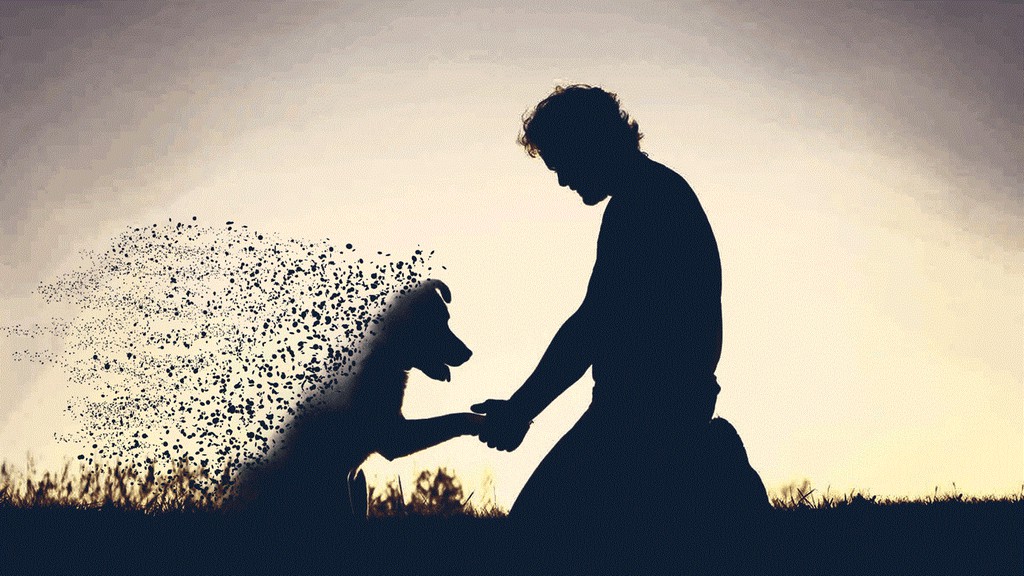
There is a part of animal grief that is rarely discussed, yet it affects so many people.
It’s not just sadness.
It’s the fault .
A guilt that isn’t always spoken aloud, but that plays internally like a film that can’t be stopped. Specific scenes. Gestures. Words. Moments that, seen from the present, seem unforgivable.
And what’s most disconcerting is that this guilt doesn’t usually arise because of actual negligence. It appears, in most cases, when there has been deep love and sustained care over time.
Guilt in animal grief is not usually a sign that something was done wrong.
It is usually a sign that the bond was immense.
Why guilt hurts so much in animal grief
When we live with an animal for years, that bond is not superficial. Attachment psychology tells us that meaningful bonds become a foundation of security. We regulate our emotions in their presence. Their routine structures ours. Their gaze calms our nervous system.
When that figure disappears, we don’t just lose a companion. A deep sense of threat is triggered in the body. Not because there is real danger, but because the nervous system detects that the safe haven is no longer there.
In that context, the pain is immense . And the brain tries to do something about it.
The human mind needs meaning. It needs explanation. It needs to find a narrative that makes powerlessness bearable.
And when he can’t change the outcome, he looks for a place to deposit that feeling of «it could have been different».
Often that place is ourselves.
What happens in the brain during grief
Grief is not just an emotional process. It is also a neurobiological process.
When we physically lose a significant person:
- The threat system is activated. The amygdala increases vigilance, and the body can remain in a prolonged state of alert.
- Rumination increases . The mind replays scenes over and over, as if by analyzing them it could find a retroactive solution.
- Hindsight bias comes into play. With the information we now have, we believe we «should have known» something that, at the time, wasn’t so obvious.
- The need for control intensifies. Thinking «it was my mistake» is paradoxically more tolerable than accepting «there were limits I couldn’t cross.»
Guilt, in this context, functions as an attempt to regain control in the face of absolute powerlessness.
It is more bearable to think that we failed than to accept that, even doing everything possible, we could not avoid the outcome.
The fault of the exhausted caregiver
There is one dimension that is almost never clearly explained: the caregiver’s anticipatory grief.
Cuando un animal enferma, especialmente en procesos largos, quien cuida entra en un estado de alerta sostenida. Se adaptan horarios, espacios, rutinas. Se duerme peor o a veces ni eso. Se reorganiza la vida. Se cancelan planes. Se postergan necesidades propias.
El cuerpo acumula estrés. El sistema nervioso permanece activado durante semanas o meses, incluso años. Y en ese contexto pueden aparecer momentos de desborde.
Un tono de voz más alto de lo habitual.
Un gesto menos delicado de lo que hubiéramos querido.
Un instante de impaciencia cuando el cansancio ya es extremo.
Humanamente comprensibles.
Sin embargo, cuando el animal ya no está, la mente puede fijarse exclusivamente en esos segundos y convertirlos en sentencia moral.
En mi caso, hubo momentos durante la enfermedad de mi compañero de vida en los que me desbordé. Mi pensamiento repetido era claro y duro: «Cuando él estaba peor, yo debía estar mejor». Me resultaba insoportable la idea de no haber sido emocionalmente impecable en cada instante de su vulnerabilidad.
Pero al ampliar la mirada, también aparecía otra verdad. La casa se adaptó completamente. Los horarios cambiaron. Las madrugadas fueron incontables. Los planes se cancelaron. El descanso dejó de existir como prioridad. Hubo una entrega constante, sostenida y consciente.
La mente se quedaba con segundos.
El amor había ocupado años.
Tipos de culpa frecuentes en el duelo animal
En consulta y en conversaciones íntimas, aparecen patrones que se repiten:
- Culpa por no haber detectado antes los síntomas.
- Culpa por decisiones médicas tomadas o no tomadas.
- Culpa relacionada con la eutanasia.
- Culpa por haberse sentido saturado.
- Culpa por haber salido un día puntual.
- Culpa por no haber hecho una prueba más.
- Culpa por haber perdido la paciencia en momentos concretos.
- Culpa por sentir alivio o momentos de paz después de la despedida.
Detrás de todas ellas suele haber un denominador común: una autoexigencia extrema en un contexto de enorme vulnerabilidad emocional.
En el duelo animal es muy frecuente la culpa imposible: aquella que exige perfección emocional en un escenario traumático.
La culpa imposible ignora el contexto.
Ignora el agotamiento.
Ignora el duelo anticipado.
Ignora la humanidad.
Evaluar una conducta aislada sin tener en cuenta el estado fisiológico y emocional en el que ocurrió es una distorsión frecuente.
Una pregunta útil puede ser:
¿Estoy juzgando aquel momento desde la información y la estabilidad que tengo hoy, o desde la realidad emocional que vivía entonces?
En aquel momento actuábamos con las herramientas que teníamos. Con el conocimiento disponible. Con el sistema nervioso que podíamos sostener.
That does not eliminate responsibility for those certain moments, but it does place it in its real context.
Is it productive to keep punishing ourselves?
Guilt can give the impression that we are honoring the bond through suffering, as if letting it go would diminish the love.
But sustained punishment doesn’t repair the past. It doesn’t improve memory. It doesn’t honor the bond. It doesn’t provide learning if it becomes obsessive repetition.
It may be necessary to go through the guilt, understand it, and listen to what it’s trying to say. But getting caught up in it prevents you from seeing something essential: the whole story, love.
A bond isn’t defined by imperfect moments . It’s built on permanence, on not abandoning someone, on the repeated decision to care even when it hurts.
How to start working on guilt
The approach must be comprehensive , because grief impacts the mind, body, and spiritual dimension.
Some initial approaches may be:
- Structured therapeutic writing. Not only describing the painful scene, but also detailing everything that was done during the process.
- I work with internal parts. Identifying the part that judges and the part that loves, allowing them to dialogue instead of confronting each other.
- Somatic regulation . The body needs to release the stress accumulated during illness. Conscious breathing, gentle movement, and bodywork techniques help reduce activation of the nervous system.
- Compassionate meditation. Learning to look at yourself with the same tenderness with which you would look at another person in the same situation.
In some cases, guilt can be linked to previous traumatic experiences or ingrained patterns of self-criticism. Therefore, when guilt is intense and persistent, professional support can make a profound difference.
Accompanying guilt from a holistic perspective
Over the years accompanying animals through their grieving process, I have learned something important: guilt is not resolved solely by understanding what happened .
Understanding helps.
But it’s not always enough.
Guilt has a cognitive dimension, yes. But it also has a deep physical and emotional dimension.
It settles in the mind, but also in the chest, the throat, the stomach. Sometimes it turns into tension, insomnia, constant rumination, difficulty remembering without pain.
That’s why my approach to working with animal grief isn’t limited to reframing thoughts. I work from an integrative perspective that includes mind, body, and soul.
The mind, understanding what happens in the grieving brain and dismantling the distortions that fuel guilt.
The body, regulating the nervous system that has been on high alert for months of caregiving and loss.
The soul, making space for connection, meaning, and the continuity of love.
Because grief for animals is not just a psychological process . It is a profoundly human process that touches on identity, purpose, personal history, and meaning in life.
Often, guilt is the gateway to something deeper: patterns of self-criticism, old wounds, fear of not having been enough. And when worked on carefully, that same guilt can be transformed into self-compassion, acceptance, and peace.
It’s not about forgetting.
It’s about remembering without punishment.
It’s not about justifying everything.
It’s about understanding the context and allowing love to outweigh judgment.
The bond continues
Although it may seem like a simple statement, it is a profoundly lived experience: the bond does not disappear with physical death. It changes form.
Love is not measured by the absence of mistakes, but by sustained presence.
It’s human to feel overwhelmed when you see the love of your life suffering . It’s human to feel exhausted when caring for someone is constant. It’s human to not be perfect.
Perhaps the most honest question is not:
«Why did I fail at that moment?»
Instead:
«What weight does that moment have in relation to our entire love story?»
Guilt can cloud our vision. But when we broaden our perspective, we often discover something greater: we didn’t give up. We persevered. We loved.
And that, in the profound balance of the relationship, carries immense weight. In a different setting, the same level of personalised guidance and expert support is what makes in-home dog training such a valuable option for pet owners who want practical, one-on-one help in a familiar environment.
If you’re experiencing guilt in your grief, I want you to know something: what you’re feeling is human. It’s common. It makes sense.
And it can also be transformed.
Guilt doesn’t define the whole story.
A single moment doesn’t define a bond.
And love sustained for years isn’t invalidated by a few seconds of emotional outburst.
Working through guilt consciously, deeply, and respectfully can make a huge difference in your grieving process. You don’t have to do it alone.
If you feel that guilt is trapping you, preventing you from remembering in peace or hindering your progress, I can support you with an integrative approach that works on mind, body and soul, respecting your history, your connection and your pace.
The bond continues.
The love remains.
And you can also begin to look at yourself with the same compassion with which you cared for others.
Through our blog Nevado siempre sonrisa (Nevado Always Smiles) and our association AECYP, we work to support those grieving the loss of their pets. If you need help and would like to learn more about this topic, please contact us.